
Electoral College - The Importance of the Electoral College
If you don't understand why the Electoral College exists, you're the reason why it exists.
The Electoral College
The Electoral College is the process by which the president is elected in America. Enshrined in Article II of our Constitution and the Twenty-Third Amendment, it preserves the United States as a federal republic rather than a simple majoritarian democracy.
America's president is not elected directly; rather, the executive is elected by the Electoral College.
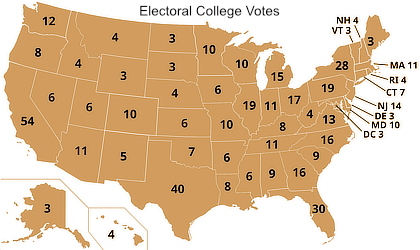
The Electoral College consists of a total of 538 electoral votes. These votes are apportioned to 51 separate presidential elections: one election in each state and one election in the District of Columbia.
Each state is assigned a number of electors equal to its number of House representatives, plus two senators. The District of Columbia is assigned three electors.
This proportion is similar to the structure of the House, which is elected by the general population, and the Senate, which until the Seventeenth Amendment was properly elected by the states.
The meeting of the electors occurs on the first Monday after the second Wednesday in December following the general election in November. A candidate must obtain 270 electoral votes at the meeting to win.
If electoral votes result in a tie, the 12th Amendment to the Constitution transfers power to elect the president to the House, and the vice president to the Senate.
Formation of the Electoral College
During the Constitutional Convention in 1787, three approaches to electing the president were debated: election by Congress, selection by state legislatures, and popular election.
Election by Congress would provide a buffer from the general public. Yet this would place the president in debt to Congress, thus rendering Congress not only the maker but effectively the executor of laws, as James Madison noted.
Selection by state legislatures would entice states to select a weak executive in order to increase their own powers, as noted by Alexander Hamilton.
Popular election could suffer the consequences of choices made by "well-meaning, but uninformed people," as Thomas Jefferson noted. George Madison stated that "The extent of the Country renders it impossible that the people can have the requisite capacity to judge of the respective pretensions of the Candidates." They were also concerned that the popular vote could be swayed by foreign governments.
The Convention as a result adopted a compromise where electors who represented both the people and the states would choose the president, thus forming the Electoral College.
The original system was modified by the 12th Amendment in 1804 to allow electors to cast separate ballots for the president and the vice president.
Balancing forms of government
The mechanism of the Electoral College balances the forms of government manifested in direct popular election of the House, and state election of the Senate as specified in the original Constitution. As noted by Mark Lewis in his article, Goodbye Electoral College, Hello Totalitarianism, Part Two, Townhall, 23 November 2026:
There are three major "forms" of government... monarchy (rule by one), aristocracy (rule by the few), and democracy (rule by the many). As America's Founders knew, as history teaches, any of those forms, governing alone, could, and usually did, become tyrannical. A monarchy often devolved into a despotism, an aristocracy into an oligarchy, and a democracy into mob rule and eventual dictatorship. Our Founders, believing in freedom, wanted to prevent that.
They did so (or tried to) by giving the President and the two Houses of Congress a share in making laws (laws restrict freedom, which makes government very dangerous). The President represents the "monarchical" form of government, the Senate is the "aristocracy," and the House is the "democratic" form. And since they didn't want any one "form" of government to have too much power, the Founders gave each one a different source of power: the President was to be elected by the Electoral College, the Senate (in the original Constitution) by state legislatures, and the House by the people. That way, no one "form" of government could become dominant or tyrannical.
Importance of the Electoral College
The Electoral College was created to:
- Create a buffer between the general population and the presidential selection process, and
- To give additional power to the smaller states, which a popular vote would deny.
Michael M. Uhlmann explains in the 26 August 2019 article As the Electoral College Goes, So Goes the Constitution that:
Hamilton and the other founders believed that the electors would be able to insure that only a qualified person becomes President. They believed that with the Electoral College no one would be able to manipulate the citizenry. It would act as check on an electorate that might be duped. Hamilton and the other founders did not trust the population to make the right choice. The founders also believed that the Electoral College had the advantage of being a group that met only once and thus could not be manipulated over time by foreign governments or others...
The Framers understood the limits of simple-minded majoritarianism of the sort embraced by direct election. If elections were simply a matter of counting heads and stopping when you got to 50% plus one, we could dispense with all the checks and balances of the Constitution, including federalism, bicameralism, the separation of powers, and, yes, the Electoral College. The point of these time-honored devices, which are all part of an integral whole, is not to circumvent popular sentiment, but to shape and channel it in ways that support the principal end for which popular government is constituted: to secure the equal rights of all. Majority rule can become majority tyranny, as the wisest thinkers on politics have always known. The trick in establishing popular government is to empower the majority without endangering the rights of minorities...
Advantages of the Electoral College
The Electoral College maintains the United States as a federal republic as opposed to a majoritarian democracy. Election disputes are resolved at the state level and do not become a nationwide legal battle.
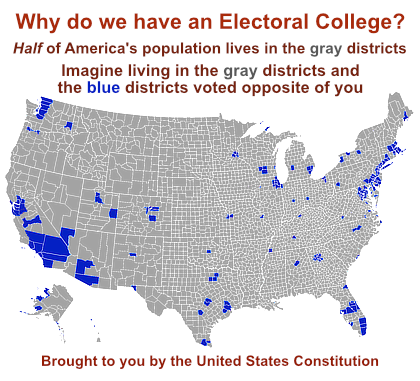
Every state is allocated at least two electors, thus preventing high-density urban coastal areas from monopolizing the election.
Today the vast majority of electors vote strictly according to party lines, counter to Hamilton's intent of electors acting independently. Nevertheless, the Electoral College still functions to force broad national consensus.
The Electoral College assures that the president is not a direct representative of the American people, but rather represent state legislators' interests. It is sufficient that the people directly elect their legislators. It is not strictly necessary that citizens participate in presidential elections, although this is maintained by convention. Indeed, the "popular vote" is a myth and is irrelevant.
Thus state legislators can appoint electors who are not aligned with the popular vote. This process can directly check election fraud in presidential elections.
Attacks on the Electoral College
Dismantling the Electoral College would remove the states from the presidential election. It would convert our constitutional republic into a simple majority-rule state.
More information on attempts to circumvent the Electoral College is available at Electoral College Attacks and the National Popular Vote (NPV).
More information on the Electoral College
The Invention of the Electoral College, by Phillip J. VanFossen, Consortium News, 5 November, 2020.
The Founders Outsmarted the Presidential Election Fraudsters, by Gary Gindler, American Thinker, 13 November 2020.
Why the Electoral College, History Central.
As the Electoral College Goes, So Goes the Constitution, by Michael M. Uhlmann, 26 August 2019.
The Mob Is Right Outside the Constitution's Wall, Breitbart, 24 May 2019:
The critique of democracy dates back to Plato and the Republic. The demos, as they were called in Greek, couldn't be trusted; they would just vote to satiate their voracious appetites at the expense of others or the nation at large...
In Madison's mind, the structure of government and the process for electing the chief executive were designed to try to fragment the power of majority.
When you read Federalist 9 (Hamilton), Federalist10, and Federalist 51 (Madison), three key elements they felt existed to help give the new United States a chance for success were its population size, geographic size, and the differing interests of the independent states. Back in the late 1700's, these factors would all make it more difficult for minority factions to attain the sort of critical mass required to do real damage....
We need these controls to prevent the very kind of efficiency in voting that can lead to majority dominance. The electoral college is one of those most fundamental controls. If we effectively neuter it through state collusion, then we move one step closer to a world our Founders feared, and that Plato described.
For those who are wondering, Plato's next stage was total tyranny...
538 Electors, 51 Elections: Why the Electoral College Still Matters, by Amil Imani, Geller Report, 17 November 2026.
Goodbye Electoral College, Hello Totalitarianism, Part Two, by Mark Lewis, Townhall, 23 November 2026.
How Does the Electoral College Actually Work? Explore the process with this seven-step graphic. The Heritage Foundation.
Election of President and Vice President, National Constitution Center.
Contingent Election of the President and Vice President by Congress: Perspectives and Contemporary Analysis, Congressional Research Service.
What Is the Contingent Election and Voting Process? Findlaw.
Video: Do You Understand the Electoral College?, The Popular Vote vs. the Electoral College, by Tara Ross, PragerU:
The Federalist Papers:
Federalist 9: Hamilton
Federalist 10: James Madison warned against the tyranny of majority factions.
Federalist 51: Madison.
Federalist 68: Alexander Hamilton defended the Electoral College as a safeguard against foreign influence, tumult, and disorder.
See the 270 To Win website for an interactive electoral college map (included below) and electoral college maps of Historical Presidential Elections.
Books on the Electoral College
The Indispensable Electoral College: How the Founders' Plan Saves Our Country from Mob Rule, by Tara Ross
We Elect a President: The Story of Our Electoral College, by Tara Ross.