
Refugee resettlement racket
Refugee resettlement in the US
Refugee resettlement in the United States is intended to provide a safe haven to those fleeing oppression and war. The Refugee Act was passed in 1980 in order to systematize refugee entry into the United States and to better provide a standard array of services to refugees. More than 2 million refugees had been resettled in the United States in the first 25 years alone after the Refugee Act was passed.1
Since 1975, approximately 2.5 million people have been resettled in the United States. As of 2007, 10 countries had resettlement programs. Of these countries, the United States accepts more than twice the number of refugees accepted by all of the other countries combined.1
The Department of State's Bureau for Population, Refugees and Migration (PRM) oversees the U.S. Refugee Admissions Program. After one year, refugees are expected to apply for permanent residence (commonly referred to as a green card) and, after five years in the United States, a refugee is eligible to apply for U.S. citizenship.6
A resettlement "case" consists of the principal applicant, his or her spouse, and unmarried children under the age of 21. Additional relatives - the extended family - may be considered for resettlement on a case by case basis.7
After the Paris Islamic terrorist attacks in November 2015, President Obama expressed commitment to bring 10,000 Syrian Refugees into the United States. See substantial CAIRCO research on this issue: Syrian refugees and national security.
Refugees in Colorado
Refugee resettlement comprises 10 percent of legal immigration into the United States. However, refugees are disproportionately settled in metropolitan communities. As of May, 2012, a total of 8,144 refugees have been resettled in Colorado.5 Denver ranked 24th in the number of refugees resettled from 1983 to 2004, with 15,848 refugees living in Denver in the year 2000.1
Colorado is designated as a participant in "Wilson Fish" alternative programs. These programs are subcontracted exclusively to voluntary agencies (VOLAGs). These programs were established under the 1984 Wilson Fish amendment to the Immigration and Naturalization Act.
This federal government website describes how VOLAGs in the 12 Wilson Fish states they operate with virtually no oversight by the state governments. For more information, see What you need to know about Wilson-Fish, by Refugee Resettlement Watch.
In Colorado, the Colorado Department of Human Services operates as a VOLAG under this program.
Colorado maintains a Colorado Refugee Services Program.8 The following FAQ is provided by the State of Colorado Department of Human Services:9
Who is a refugee?
A refugee is a person who "owing to a well-founded fear of being persecuted for reasons of race, religion, nationality, membership in a particular social group, or political opinion, is outside the country of his nationality, and is unable to or, owing to such fear, is unwilling to avail himself of the protection of that country." This definition comes from the Refugee Act of 1980 which takes its definition of refugee from the 1951 United Nations Convention relating to the Status of Refugees and its 1967 protocol.
Who is an asylee?
When people flee their own country and seek sanctuary in another country, they apply for asylum – the right to be recognized as a refugee and receive legal protection and material assistance. An asylum seeker must demonstrate that his or her fear of persecution in his or her home country is well-founded.
How many refugees are resettled in the U.S.?
In recent years the annual admissions levels for refugees has been set at 76,000 persons. Each year, after consultation with Congress, the U.S. Department of State, and refugee-related agencies, the President signs a Presidential Determination regarding the number of refugees to be resettled in the U.S. The 2012 Presidential Determination allows for up to 76,000 refugees.
How many refugees are resettled in Colorado?
Last year [2011], 1878 refugees were resettled in Colorado. In 2012, 2000 refugees are projected to be resettled in Colorado. (Click here for additional data.)
Where are refugees resettled in Colorado?
The majority of refugees are resettled in the Denver metro area. Approximately 100 refugees are resettled in Colorado Springs each year and Larimer County is beginning to receive refugees.
Where do refugees come from?
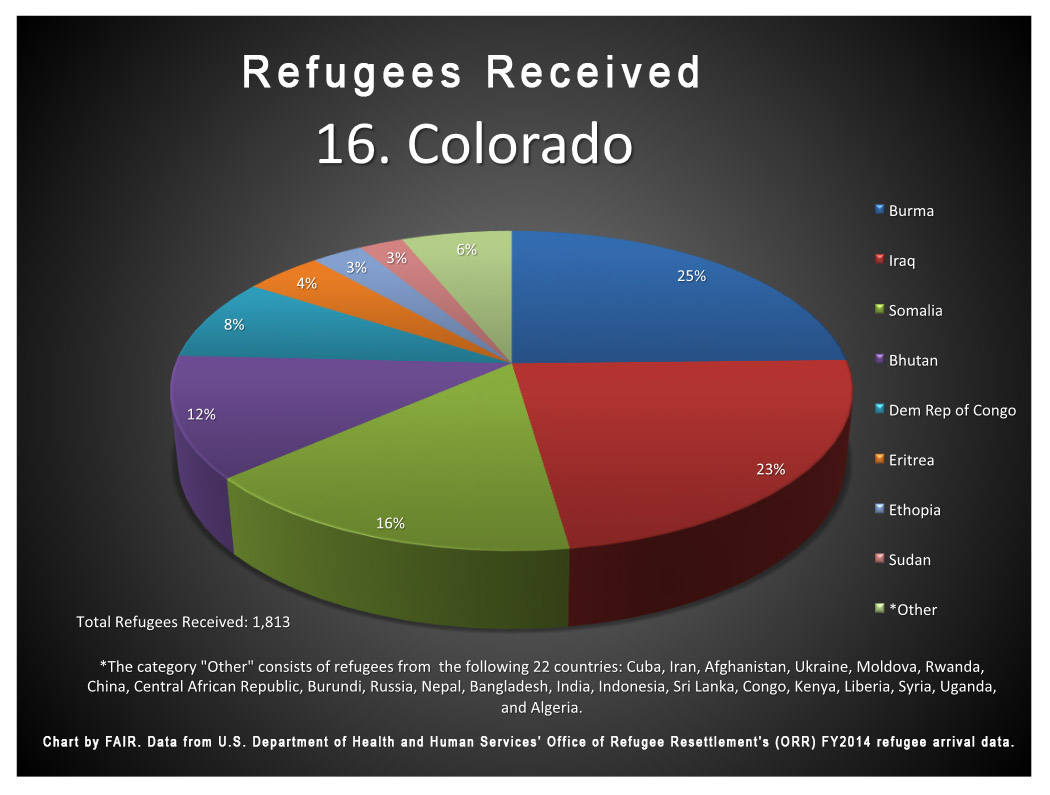
Refugees are resettled from many different countries around the world. Over the last few years the countries with the highest number of resettled refugees are from: Burma; Iraq; Bhutan; and Somalia. (Click here for additional data.)
What is the Colorado Refugee Services Program (CRSP)?
CRSP is a division of the Colorado Department of Human Services and funded by the U.S. Department of Health and Human Services' Office of Refugee Resettlement, under the authority of the Refugee Act of 1980. Its goal is to ensure effective resettlement of officially designated refugees and to promote refugee self sufficiency and integration.
Where does funding come from for refugee resettlement?
Funding comes from the U.S. Department of Health and Human Services' Office of Refugee Resettlement.
Who provides services to refugees?
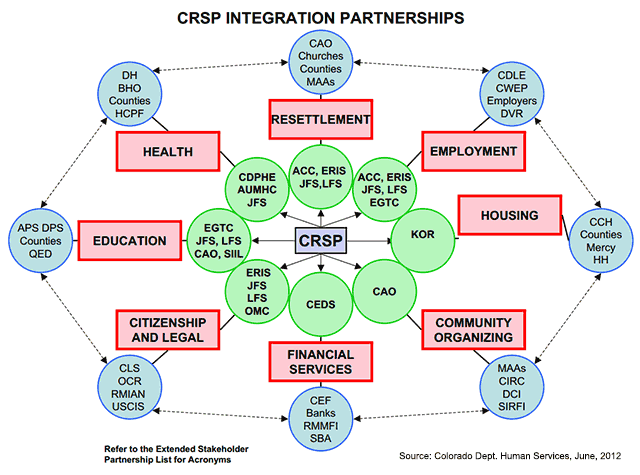
CRSP works with many community partners, but primarily with three designated refugee resettlement agencies (often referred to as VOLAGS): African Community Center, Ecumenical Refugee and Immigration Services and Lutheran Family Services Refugee and Asylee Programs. Here is the contractor and principal partner resources map shown above. Here is the extended stakeholders and partnership list.
Updated List: Department of State Bureau of Population, Refugees, and Migration Office of Admissions - Refugee Processing Center Affiliate Directory
Colorado - Affiliate Directory, Page 6 - Nov. 2014
- LIRS; CO-LIRS-02: Lutheran Family Services Of Colorado 132 E Las Animas, Colorado Springs, CO 80903 Phone: 719-314-0223
- LIRS; CO-LIRS-04: Lutheran Family Service Of Colorado 108 E. Saint Vrain Street, Suite 21,Colorado Springs, CO 80903 Phone: 719-314-0213
- CWS; CO-CWS-01: Ecumenical Refugee Services, Inc. 1600 Downing Street, Suite 400, Denver, CO 80218 Phone: 303-860-0128
- DFMS; CO-DFMS-01: Ecumenical Refugee Services 1600 Downing Street, Suite 400, Denver, CO 80218 Phone: 303-860-0128
- ECDC; CO-ECDC-01: ECDC African Community Center 5250 Leetsdale Drive, Suite 200, Denver, CO 80246 Phone: 303-399-4500
- LIRS; CO-LIRS-01: Lutheran Family Services Of Colorado 1600 Downing Street, Ste 600, Denver, CO 80218 Phone: 303-980-5400 ext 182
- LIRS; CO-LIRS-03: Lutheran Family Services Of Colorado 363 S. Harlan Street, Suite 105, Denver, CO 80226 Phone: 303-217-5846
- LIRS; CO-LIRS-05: Lutheran Family Services Of Colorado 800 8th Avenue, Suite 225, Greeley, CO 80631 Phone: 970-336-2201
Related: President Obama issued an executive memorandum dated Nov. 21, 2014, to all federal agencies directing them on “Creating Welcoming Communities and Fully Integrated Immigrants and Refugees.”
What services do refugees receive?
Services include, but are not limited to: ESL classes, job training and employment placement, cash assistance, legal services, and health care.
Voluntary program
Refugee resettlement is a voluntary program. Cities can choose whether to participate in the program. As of October 1, 2011, withdrawal from the refugee program is allowed per current law:
§ 400.301 Withdrawal from the refugee program.(a) In the event that a State decides to cease participation in the refugee program, the State must provide 120 days advance notice to the Director before withdrawing from the program.4
Ten reasons for a refugee resettlement moratorium
Testimony given to the U.S. State Department by Ann Corcoran, Refugee Resettlement Watch.
A moratorium should be put in place until the program is reformed and the economy completely recovers.
1) There are no jobs. The program was never meant to be simply a way to import impoverished people to the US and place them on an already overtaxed welfare system.
2) The program has become a cash cow for various “religious” organizations and other contractors who very often appear to care more about the next group of refugees coming in (and the cash that comes with each one) than the group they resettled only a few months earlier. Stories of refugees suffering throughout the US are rampant.
3) Terrorist organizations (mostly Islamic) are using the program that still clearly has many failings in the security screening system. Indeed consideration should be given to halting the resettlement of Muslims altogether. Also, the UN should have no role in choosing refugees for the US.
4) The public is not confident that screenings for potential terrorists (#3) or the incidences of other types of fraudulent entry are being properly and thoroughly investigated and stopped. When fraud is uncovered—either fraud to enter the country or illegal activity once the refugee has been resettled—punishment should be immediate deportation.
5) The agencies, specifically the Office of Refugee Resettlement (ORR), is in complete disarray as regards its legally mandated requirement to report to Congress every year on how refugees are doing and where the millions of tax dollars are going that run the program. The last (and most recent) annual report to be sent to Congress is the 2008 report—so they are out of compliance for fiscal years 2009, 2010 and 2011. A moratorium is necessary in order for the ORR to bring its records entirely up-to-date. Additionally, there needs to be an adequate tracking system designed to gather required data—frankly some of the numbers reported for such measures of dependence on welfare as food stamp usage, cash assistance and employment status are nothing more than guesses. (The lack of reports for recent years signals either bureaucratic incompetence and disregard for the law, or, causes one to wonder if there is something ORR is hiding.)
6) The State Department and the ORR have so far failed to adequately determine and report (and track once the refugee has been admitted) the myriad communicable and costly-to-treat diseases entering the country with the refugee population.
7) Congress needs to specifically disallow the use of the refugee program for other purposes of the US Government,especially using certain refugee populations to address unrelated foreign policy objectives—Uzbeks, Kosovars, Meshketians and Bhutanese (Nepalese) people come to mind.
8) Congress needs to investigate and specifically disallow any connection between this program and big businesseslooking for cheap and captive labor. The federal government should not be acting as head-hunter for corporations.
9) The Volag system should be completely abolished and the program should be run by state agencies with accountability to the public through their state legislatures. The system as presently constituted is surely unconstitutional. (One of many benefits of turning the program over to a state agency is to break up the government/contractor revolving door that is being demonstrated now at both the State Department and ORR.) The participating state agency’s job would be to find groups, churches, or individuals who would sponsor a refugee family completely for at least a year and monitor those sponsors. Their job would include making sure refugees are assimilating. A mechanism should be established that would allow a refugee to go home if he or she is unhappy or simply can’t make it in America. Short of a complete halt to resettlement-by-contractor, taxpayers should be protected by legally requiring financial audits of contractors and subcontractors on an annual basis.
10) As part of #9, there needs to be established a process for alerting communities to the impending arrival of refugees that includes reports from the federal government (with local input) about the social and economic impact a certain new group of refugees will have on a city or town. This report would be presented to the public through public hearings and the local government would have an opportunity to say 'no'.
Resources
Refugee Resettlement Watch is the premier information resource for resettlement of foreigners in America. Refugee Resettlement Watch monitors resettlement of foreign nationals / communities / tribes forced upon unsuspecting American communities. These resettlement programs are funded almost entirely by government grants issues to non-profits such as religious groups.
See The Social Contract Summer, 2013 issue: Resettlement Racket for many pertinent articles on refugee resettlement forced upon American communities, including:
- The Refugee System Has Become a Racket
- Who are the top Volags?
- Refugee and Asylum
- State Department Uses Wrong Criteria in Conferring Refugees' Eligibility
- Refugee Industry Drives U.S. Refugee Policy
- America’s Lax Refugee Program Admits Culturally Inappropriate and Dangerous Foreigners
- Refugee Resettlement - A System Badly in Need of Review
- Tennessee Needs to Regain Role As Refugee Coordinator
- How the Refugee Policy Impacts Local Communities — A Firsthand Account
- Another Firsthand Account from Minnesota
- South Carolina Town Blocks Refugee Resettlement - Cayce resident speaks out in exclusive interview
- Pro-Amnesty Movement Blessed by Church Bosses - Is the disconnect between the hierarchy and those in the pews expanding?
- ‘This guy shouldn’t have been in America’ — Obama’s Willie Horton
- Political Asylum: Where Compassion and National Security Intersect
- Refugee Problems in Arizona
- Why Did the Press Ignore the Fort Dix Terrorist Plot?
- Democrat Says Amnesty Threatens the ‘Social Contract’
- In Their Own Words... A Not-So-Hidden Agenda
- Bill Clinton’s Legacy Apparently, Minnesota was deemed too clean and safe
- ‘Refugee’ Yemeni Jews to Monsey, New York Is a Small Example of Fraud in U.S. Refugee Program
Limits to Growth articles on refugee resettlement cover aspects of forced resettlement on American communiies that the mainstream media conveniently ignore.
Videos
Ann Corcoran from Refugee Resettlement Watch discusses third-world refugee resettlement, including the UN directed resettlement of foreign Muslims who are antagonistic to American democracy.
Ann Corcoran from Refugee Resettlement Watch discusses the U.S. Refugee Resettlement Program and its impact on unsuspecting local communities. These communities are often forced to accept large groups of refugees that are extremely difficult to assimilate into American culture (two parts). Presentation from the October 4, 2009 Social Contract Writers Workshop.
Investigative reporter James Simpson discusses refugee resettlement and the implicit agenda to erase America as we know it. This presentation was given at the October 2015 Social Contract Writers Workshop in Washington, DC:
Don Barnett discusses the U.S. Refugee Resettlement Program and how it draws immigrants to settle in America (two parts). Presentation from the October 4, 2009 Social Contract Writers Workshop.
The following video is the best summary video on refugee resettlement: Global humanitarian reasons for current U.S. immigration are tested in this updated version of immigration author and journalist Roy Beck's colorful presentation of data from the World Bank and U.S. Census Bureau. The 1996 version of this immigration gumballs presentation has been one of the most viewed immigration policy presentations on the internet.
Presented by immigration author/journalist Roy Beck.
References
1. "Refugee Resettlement in Metropolitan America", By Audrey Singer and Jill H. Wilson, (The Brookings Institution, March, 2007). Published online by the Migration Policy Institute.
2. Audrey Singer and Jill H. Wilson, "From 'There' to 'Here': Refugee Resettlement in Metropolitan America," (The Brookings Institution 2006).
3. Office of Refugee Resettlement. 2004. Report to the Congress, FY 2004.
4. Code of Federal Regulations:
Title 45 - Public Welfare Volume: 2
Date: 1999-10-01; Original Date: 1999-10-01
Title: Section 400.301 - Withdrawal from the refugee program.
Context: Title 45 - Public Welfare. Subtitle B - Regulations Relating to Public Welfare. CHAPTER IV - OFFICE OF REFUGEE RESETTLEMENT, ADMINISTRATION FOR CHILDREN AND FAMILIES, DEPARTMENT OF HEALTH AND HUMAN SERVICES. PART 400 - REFUGEE RESETTLEMENT PROGRAM.
5. US Department of State Refugee Processing Center, Reports - Admissions and Arrivals.
6. US Department of State - Refugee Admissions.
7. U.S. Citizenship and Immigration Services, I-130, Petition for Alien Relative.
8. Colorado Refugee Services Program.
9. Colorado Department of Human Services - Refugee Resettlement - FAQ.
10. "Time To Cap The Refugee Industry", by Thomas Allen, VDare, May 6, 2003
"...The refugee Iron Triangle is also aided by a lawyer lobby—and a media which is seemingly incapable of reporting truthfully on the issue. The Refugee Industry as we know it would end tomorrow if even one quarter of refugee costs were the responsibility of its champions..."
11. "Refugee Industry Snows the Media—For Now", by Thomas Allen, VDare, July 31, 2002
12. About refugee health, Colorado Department of Public Health and Environment. Interestingly, in what must be an obvious attempt at obfuscation, definitions by race/ethnicity do not include Hispanic/Latino. See: Refugee arrivals to Colorado by race/ethnicity and year.
13. The Great Somali Welfare Hunt, by Roger D. McGrath, American Conservative, November 18, 2002.
14. Refugee Resettlement Fact Sheet from Refugee Resettlement Watch - the premier information resource for resettlement of foreigners in America.
15. Ten things your town needs to know when welcoming refugees for the first time, Refugee Resettlement Watch, March 11, 2015.
16. New Publication: How Immigration and Refugee Resettlement Are Used as a Weapon against America, Limits to Growth, July 24, 2015:
A five-minute video, titled the Red-Green Axis: Refugees, Immigration and the Agenda to Erase America, from the Center for Security Policy and is a preview of a 65-page monograph of the same name.
17. Refugee Resettlement: The Lucrative Business of Serving Immigrants, James Simpson, Capitol Research Center, July, 2015. (PDF version: Refugee Resettlement: The lucrative business of serving immigrants).
18. Time to bring refugee program out of the shadows, Don Barnett, Center for Immigration Studies, March, 2014.
19. Fog of ignorance and misinformation around this program is media’s fault, Don Barnett, Refugee Resettlement Watch, August 13, 2015.
20. Immigration Basics: Refugees, FAIR, November 19, 2015.
To qualify as a refugee, a person must meet the following definition from Section 101(a)(42) of the Immigration and Nationality Act:
"any person who... is unable or unwilling to return to, and is unable or unwilling to avail himself or herself of the protection of that country because of persecution or a well-founded fear of persecution on account of race, religion, nationality, membership in a particular social group, or political opinion...."
The distinction between a refugee and an asylee is that refugees apply for entry to the U.S. from abroad, and asylees are already in the U.S., legally or illegally, when the application is made...
Our refugee policies were codified 35 years ago under The Refugee Act of 1980. They were designed to address the political realities of the Cold War era, in which persecution was most often perpetrated by powerful and repressive central governments. These governments actively prevented their citizens from leaving.
Contemporary refugee situations, more often than not, are the consequence of the breakdown of government control in a growing number of countries around the world. In their place, violent militias driven by religious fanaticism, ethnic separatism, criminal enterprise, and other factors are wreaking havoc on people in a rapidly increasing number of failed states. These religious, nationalist and criminal insurgents, and the weak governments they are challenging for power, actively encourage mass outflows of migrants.
U.S. refugee laws need to be updated to allow the United States to respond to humanitarian crises, while protecting vital national interests.
ISIS and other terrorist groups have vowed to use the freedom and openness of our societies to attack us. We would be fools not to believe them... the failure to assimilate immigrants and their children into the economic and cultural mainstream can be lethal.
21. The Role of States in the Refugee Resettlement Process, FAIR, November 2015.
22. Islam and the West... Can They Co-Exist?, video of Lawrence Auster speaking on muslim immigration, assimilation, the Constitution and Islam, January 28, 2010.
23. The UN's Role in U.S. Refugee Resettlement, Center for Immigration Studies, January, 2015.
24. Evaluating Refugee Demographics Nationally and State-wide: Part 1 and Part 2, FAIR, February 19, 2016. See the complete report: Refugees in the United States: A Snapshot FY2014 Refugee Arrivals, FAIR.
25. The Impact of Refugees on the Size and Security of the U.S. Population, by Edwin S. Rubenstein, NPG, June 8, 2016.
26. Do States Have a Say in the Refugee Resettlement Program? Tennessee lawsuit highlights federal overreach, by Don Barnett, Center for Immigration Studies, January 24, 2018.
27. The Fiscal Cost of Resettling Refugees in the United States, FAIR, February 5, 2018.