CAIR - Colorado Alliance for Immigration Reform

Sanctuary policies for illegal aliens

Also see:
Overview of Denver sanctuary policy.
Denver's illegal alien hiring hall (Dec, 2005). Protest (Jan, 2006).
Articles on sanctuary policy for illegals.
CAIR May 16 protest & news conference:
       pictures     news release
       statements by Lamm,   Tancredo
       letter to Mayor     letters to the editor.
Executive Order 116:
       Webb     article     legal opinion.
Denver Police policy.
Audio clips - Hickenlooper and others
 
Research:
Federal law requires full cooperation between localities and the INS (ICE).
Immigration Law Enforcement by Local Agencies
Sanctuary Cities and States -- Undermining the American Republic
Supreme Court Ruling Razes Artificial Fire Wall Between Local Law Enforcement and Immigration Enforcement
Role of State and Local Police In Immigration Law Enforcement
Non-Cooperation Policies

Sanctuary cities banned in Colorado!

Update: Wiens measure becomes law, bans sanctuary cities

May 2, 2006
Kelley Harp, Senate Republican Communications

DENVER – Senate Bill 90, by state Sen. Tom Wiens, R-Castle Rock, was signed into law Monday by Colorado Gov. Bill Owens. The measure prevents cities and local governments from implementing sanctuary policies allowing illegal aliens to live within their borders without any fear of punishment.

The new law accomplishes this by prohibiting the administration of grants by the Department of Local Affairs to any local government that declares itself a sanctuary city.

“Illegal immigration is clearly a major problem in this country,” Wiens said. “All levels of government must work together if we want to find practical and effective solutions to this problem. This bill provides the necessary consequences currently missing in state law to punish local governments who instruct their officers to blatantly ignore federal law.”

Senate Bill 90, would require all local law enforcement officers to report to federal immigration officials any person arrested in their jurisdiction who they reasonably believe to be an illegal alien. The bill would also require each city and county in Colorado to report to the General Assembly whether or not it has instructed their peace officers to cooperate with state and federal officials in the enforcement of immigration laws.

“This bill received strong bipartisan support throughout the process,” Wiens said. “With this in mind, my hope is this bill will encourage important debate on the subject at the municipal and county levels as well as greater enforcement of our current immigration laws.”

Senate Bill 90 became law immediately upon the governor’s signature.

The key provisions of the statute are as follows:

  • Local governments cannot create a policy that bars police from cooperating with federal officials concerning the status of any person in Colorado.
  • Police must notify the U.S. Immigration and Customs Enforcement agency if a person arrested for a crime is a suspected illegal immigrant.
  • The law does not apply to those arrested for minor traffic infractions or suspicion of domestic violence. However, immigration officials must be told if a person is convicted of domestic violence.
  • Cities and counties must notify local law enforcement officers in writing of their obligation to comply with the law.
  • Cities and counties must file an annual report to the state regarding how many illegal immigrants they reported to immigration officials.
  • Local governments that fail to report suspected illegal immigrants will not be eligible for state grants.

Background

The United States has the most generous immigration policy in the world, allowing approximately one million legal immigrants into our country every year. In addition, approximately 3 million illegal aliens sneak into our country every year (Time Magazine, September 20, 2004).

However, many cities have implemented sanctuary policies which call for city employees - including police officers - not to report illegal aliens to the federal authorities. Many sanctuary cities, in contrast to the wishes of most Americans, also offer public services and benefits to illegal aliens that impose great fiscal and social costs on the taxpayers. Sanctuary cities are illegal, made so by federal legislation enacted in 1996.1 While the federal government has abdicated its responsibility to enforce that law, legal action is now being pursued against some sanctuary cities.

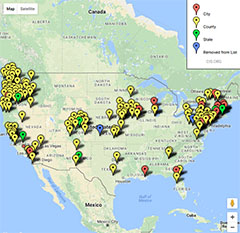
Colorado has several sanctuary cities.

Fort Collins, Colorado

Thanks to the efforts of concerned sovereign Coloradans, on October 4, 2005, the city of Fort Collins, Colorado, voted down a proposed ordinance that effectively would have made the city a sanctuary for illegal aliens. The resolution, two years in the making and written under the guise of protecting "immigrant rights", was in effect a sanctuary city policy. Read more about the policy and its defeat. See articles and more information.

Denver, Colorado

On December 2, 2005, concerned sovereign Coloradans surprised Denver Mayor John Hickenlooper at a burrito breakfast fundraiser at El Centro - Denver's Illegal Alien Hiring Hall. Citizens questioned him on Denver's sanctuary city policy and demanded the Denver Police Manual be changed to require full cooperation with Immigration and Customs Enforcement (ICE).

See pictures and video of the confrontation and of Denver's illegal alien hiring hall.

On May 8, 2005, Denver Police officer Don Young was assassinated in cold blood by an illegal alien employed at Denver Mayor Hickenlooper's restaurant. The horror is that Denver has an illegal alien sanctuary policy (Executive Order 116), implemented by former Mayor Webb in 1998, which:

  • Declares Denver's strong opposition to federal distinctions between legal immigrants and commits city officials "to the delivery of services to all of its residents."
  • Asserts that federal policy "unfairly impacts many of Denver's children, senior citizens and disabled residents."
  • Vows that the city will back legal rights of all residents in Denver, adding that Webb will urge businesses, schools, hospitals and universities to do the same.

Recently, City Attorney Finegan issued an opinion that Denver does not have a sanctuary policy and that Congressman Tancredo is wrong in saying that it does. Yet this opinion flies in the face of a 1999 City Attorney opinion on 116 that states the following:

  • Executive Order No. 116 is a limited cooperation ordinance. A limited cooperation ordinance recognizes that illegal or undocumented aliens are present in the United States in great numbers. Such limited cooperation ordinances recognize the immigration problem and offer a solution by making adjustments for the benefit of public safety.
  • Executive Order No. 116 discourages reporting of undocumented aliens who seek essential services.
  • ... illegal entry is a criminal offense which can be enforced by both state and federal officials, whereas illegal presence is a civil offense enforceable only by the INS.
  • Since the courts have strictly limited the enforcement of immigration laws by state and local law enforcement to the criminal provisions, it is clear that state and local law enforcement are under no affirmative duty to gather information on an individual's immigration status or to report a violation. Therefore, limited cooperation ordinances, like Executive Order No. 116, merely codify what the courts have already decided and that is, state and local officials have no jurisdiction to enforce civil provisions of federal immigration laws.
  • Moreover, both the present [police] departmental policy 104.5 and the interim policy, § 103.52(3) go further and restrict officers from enforcing even the criminal portions of the INA, without prior approval from a supervisor or commander.

Another order, Executive Order 119, authorized Denver to accept bogus Mexican Matricula Consular IDs, until prohibited by state law. Denver's police department operations manual states, "Generally, officers will not detain, arrest, or take enforcement action against a person solely because he/she is suspected of being an undocumented immigrant." It is not just Executive Orders 116 and 119, but rather these orders in conjunction with Denver's Police operations manual and city and police practices that embody Denver's sanctuary policy.

Denver's sanctuary policy is nothing more than a de facto amnesty for illegal aliens, including known felons. Denver's police officers are handcuffed by Denver's sanctuary policy. They are effectively prevented from notifying immigration authorities about the presence in Denver of illegal aliens. This amnesty for foreign criminals places the safety and welfare of citizens at risk, and IT MUST STOP NOW!!


Notes

1 Recognizing the adoption of sanctuary policies as a growing impediment to combating the wave of illegal aliens residing in the country, Congress adopted measures in 1996 that barred local ordinances that prohibited employees from providing information on illegal aliens to federal officials. The law says, “Notwithstanding any other provision of Federal, State or local law, a Federal, State, or local government entity or official may not prohibit or in any way restrict any government entity or official from sending to or receiving … information regarding the citizenship or immigration status, lawful or unlawful, of any individual.” - § 434 of the Personal Responsibility and Work Opportunity Reconciliation Act of 1996 (PRWORA), and § 642 of the Illegal Immigration Reform and Immigrant Responsibility Act of 1996 (IIRIRA).


For legal information on sanctuary city policies, see CAIR's legal section. Of particular interest is the March 22, 2005 Supreme Court ruling that local law enforcement may cooperate with federal immigration enforcement.