
Population Pushing Earth Past the Breaking Point
We have known since the 1970s that infinite population growth on a finite planet - and within finite nation boundaries - cannot be sustained.
The following article summarizes our predicament:
Global human population is pushing Earth past its breaking point, by Flinders University, Phys, 30 March 2026. Here are a few excerpts:
... Published in Environmental Research Letters, the study shows that humans have pushed well beyond the planet's long-term capacity and that continued growth under current patterns of consumption will intensify environmental and social challenges for communities worldwide.
The research examined more than two centuries of global population data and uncovered a major shift in human population dynamics that began in the mid-twentieth century...
"Earth cannot keep up with the way in which we are using resources. It cannot support even today's demand without major changes, with our findings showing that we are pushing the planet harder than it can possibly cope," says Professor Bradshaw from the Global Ecology Laboratory in the College of Science and Engineering...
"... global population is likely to peak somewhere between 11.7 and 12.4 billion people by the late 2060s or 2070s if current trends hold."...
Professor Bradshaw says this upper limit is dangerous and has only been possible to date because human societies have relied on fossil fuels and drained natural resources faster than nature can replace them.
"The truly sustainable population is much lower and closer to what the world supported in the mid-twentieth century. Our calculations show a sustainable global population closer to about 2.5 billion people if everyone were to live within ecological limits and comfortable, economically secure living standards," he says...
The consequences of overshooting Earth's 'biocapacity' [carrying capacity] include stronger climate impacts, declining biodiversity, reduced food and water security, and widening inequality...
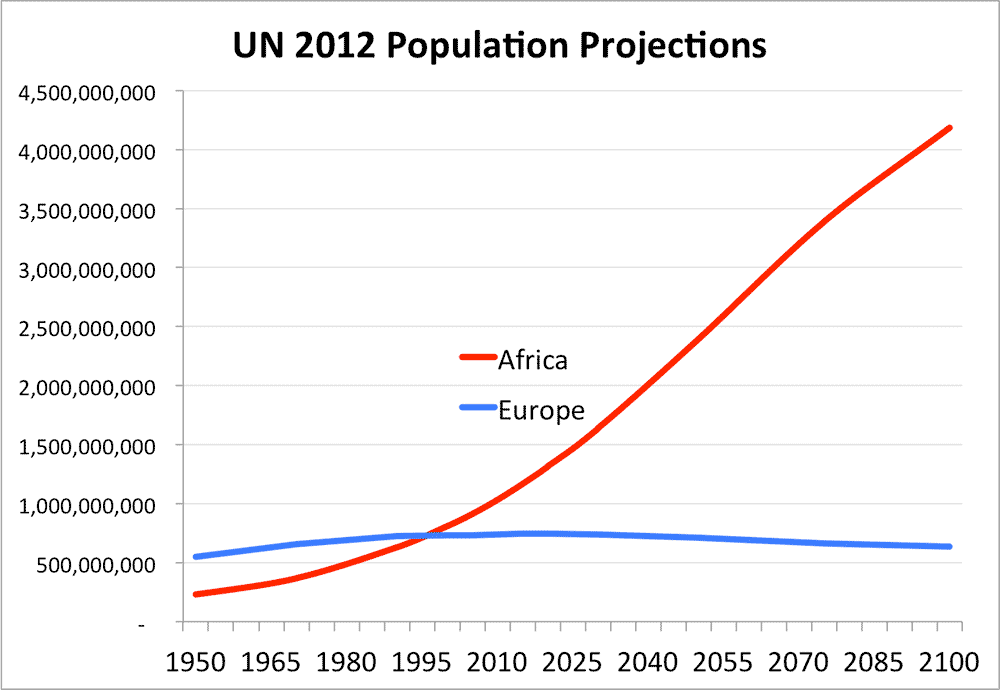
For a perspective on projected population growth, see this article: World Fertility - The World's Most Important Graph. Here's one graph from the article:
Norman Bourlaug was the father of the "green revolution," which used fertilizer derived from petroleum to bolster agricultural yield. He stated in his Nobel Lecture, 11 December 1970 that:
The green revolution has won a temporary success in man's war against hunger and deprivation; it has given man a breathing space. If fully implemented, the revolution can provide sufficient food for sustenance during the next three decades. But the frightening power of human reproduction must also be curbed; otherwise the success of the green revolution will be ephemeral only.
Most people still fail to comprehend the magnitude and menace of the "Population Monster". In the beginning there were but two, Adam and Eve. When they appeared on this earth is still questionable. By the time of Christ, world population had probably reached 250 million. But between then and now, population has grown to 3.5 billion. Growth has been especially fast since the advent of modern medicine. If it continues to increase at the estimated present rate of two percent a year, the world population will reach 6.5 billion by the year 2000. Currently, with each second, or tick of the clock, about 2.2 additional people are added to the world population. The rhythm of increase will accelerate to 2.7, 3.3, and 4.0 for each tick of the clock by 1980, 1990, and 2000, respectively, unless man becomes more realistic and preoccupied about this impending doom. The ticktock of the clock will continually grow louder and more menacing each decade. Where will it all end?
Malthus signaled the danger a century and a half ago. But he emphasized principally the danger that population would increase faster than food supplies. In his time he could not foresee the tremendous increase in man's food production potential. Nor could he have foreseen the disturbing and destructive physical and mental consequences of the grotesque concentration of human beings into the poisoned and clangorous environment of pathologically hypertrophied megalopoles. Can human beings endure the strain? Abnormal stresses and strains tend to accentuate man's animal instincts and provoke irrational and socially disruptive behavior among the less stable individuals in the maddening crowd.
Related
Caring for Our Mother Earth - A Timely Documentary That Confronts the Taboo of Overpopulation
Limits to physical and economic growth
Nitrogen and the people of Sri Lanka
Book: Elephants in the Volkswagen: Facing the Tough Questions About Our Overcrowded Country, by Lindsey Grant.
Exceeding the carrying capacity of a habitat, which usually leads to a population crash and dieoff. See:
- Video: Arithmetic, Population and Energy - a talk by Al Bartlett.
- Carrying Capacity and Overshoot: Another Look, by Paul Chefurka.
- Book: Overshoot: The Ecological Basis of Revolutionary Change, by William R. Catton. Recommended reading.
- Book: Collision Course: Endless Growth on a Finite Planet.