SCOTUS Sadly Affirms Birthright Citizenship
The U.S. Supreme Court voted 5-4 on Tuesday to reject President Donald Trump's reform of the nation's birthright citizenship policy, which now grants the huge prize of citizenship to nearly all infants born in the United States, even if the parents are illegal migrants [illegal alien invaders] or temporary visitors.
The long 194-page Trump v. Barbara decision says Trump’s order violates the 14th Amendment of the Constitution...
The right applies even to foreign parents who sneak across the United States borders with Canada and Mexico, or who enter as temporary workers or tourists, Roberts insisted...
Related
Justice Alito: Birthright Citizenship Is 'Grotesque', Breitbart, 30 June 2026 [page 153 of Trump v. Barbara]:
"This is one of the most important decisions in the history of the Court, and in my judgment, the Court has made a serious mistake," Justice Samuel Alito wrote in his dissent to the Supreme Court's 5-4 decision to insert birthright citizenship into Americans' Constitution.
He continued in plain language to show how the decision endorses birth tourism, which would automatically grant full citizenship to foreign adults who have never lived a full day in the United States:
The Court’s interpretation is not only contrary to the original meaning of the Fourteenth Amendment, it produces grotesque results. While foreigners who wish to immigrate lawfully must sometimes wait for many years, a child born here to a birth tourist is automatically a citizen.
The Court's interpretation also has national-security implications… Suppose that a person's only connection to this country is that he was born here to a mother who was present just long enough to give birth and then quickly returned to her native country. Suppose that country is a strategic adversary or enemy of the United States. Suppose the child never visited the United States while growing up and was inculcated with hatred of this country. According to the Court, that person is a citizen of the United States. He can enter and leave the country as he pleases. He can travel the world on a United States passport. Even if he plots to harm this country, he cannot be deprived of his status as a citizen, at least under current precedent.
"We should not adopt an erroneous interpretation of the Fourteenth Amendment simply out of fear of the consequences of 'rocking the boat' or as a reaction to current immigration policy," he wrote...
"The Fourteenth Amendment does not include the rule the Court now imposes on the country," Alito wrote, adding, "In my judgment, the Court has made a mistake that will seriously affect the country's future."
Justice Clarence Thomas Dissents: Birthright Citizenship Claim Is Based on Feudalism, Breitbart, 30 June 2026:
Justice Clarence Thomas says the Supreme Court's 5-4 court decision today establishing birthright citizenship as a constitutional right is a modern political project built on a feudal principle rejected by the American Revolution that devalues U.S. citizenship...
Thomas’s dissent [page 62 of Trump v. Barbara], which was co-signed by Justice Neil Gorsuch, explained his view:
The Citizenship Clause was consistently interpreted not to apply to the children of foreign temporary visitors, who were by definition not domiciled in the United States. Regardless of administration or party, the Federal Government for decades after ratification regularly denied claims to citizenship by children who were born in the United States but not domiciled here. When a child was "born" in the United States to parents "domiciled" abroad, he was "not, therefore, under the statute and the Constitution a citizen of the United States by birth"... Scholars agreed: A child "born within the territory of the United States, of alien parents" was not a citizen unless his parents were "permanently domiciled within the United States"... This Court agreed: The Citizenship Clause "exclude[d] from its operation children of… citizens or subjects of foreign States born within the United States"... And, Congress agreed: The Citizenship Clause did not extend to a child born here but "subject to any foreign power"... As Justice Harlan would write in his [Supreme Court] dissent in Plessy v. Ferguson... the Citizenship Clause "gave citizenship to all born or naturalized in the United States and residing here"...
The [Supreme] Court offers a different account. American citizenship, the Court says, was based on a medieval English "feudal" principle, according to which each person "owed personal service to the lord of the soil" as his "master" - a perpetual servitude that was "born with the child and only ended in the grave"... Americans, the Court says, adopted this feudal principle as a rule of American citizenship "with little fanfare"... Then, according to the Court, the Reconstruction Congress codified that feudal principle with the words "not subject to any foreign power" in the Civil Rights Act and "subject to the jurisdiction thereof" in the Citizenship Clause. Then, the Court says, the Claus's meaning was definitively settled by dicta in United States v. Wong Kim Ark...
With due respect, the Court's account is not historically accurate. The Court says that the Citizenship Clause incorporated the English feudal principle that subjects owed lifetime servitude to the King who owned the soil on which they were born, but Americans - unsurprisingly - rejected this feudal principle. The Court's theory of American citizenship is based on the opinion of a New York assistant vice chancellor in an inheritance dispute called Lynch v. Clarke, ... But, the assistant vice chancellor's reasoning, whatever it was worth, was not even followed in New York by the time of the Citizenship Clause. Finally, the Court reasons that dicta in Wong Kim Ark settled the meaning of the Clause. But, Wong Kim Ark itself emphasized that its holding was limited to persons domiciled in the United States. And, scholars and government officials continued to agree after Wong Kim Ark that the Citizenship Clause did not extend to the children of foreign temporary visitors. The rule remained what it always was: A child born on American soil of "a stranger or traveler passing through the country, or temporarily residing here," was "not a citizen."...
The court's decision leaves American citizens with no avenue to guard their citizenship except a formal constitutional amendment enacted via a two-thirds majority of the federal Congress or of the states.
1776, Not 1608: What the Supreme Court Got Wrong on Birthright Citizenship, by John C. Eastman, American Mind, 30 June 2026:
Chief Justice John Roberts begins the Supreme Court's birthright citizenship opinion in Westminster in 1608 with Calvin's Case and the English law of royal subjectship.
I would begin in Philadelphia in 1776.
Between those two places - and those two moments - lies the American Revolution. And the Revolution changed more than who governed America. It changed the very foundation of political membership...
Roberts proves that England followed jus soli. He proves that English subjects acquired allegiance by birth within the king's dominions. He proves that Wong Kim Ark embraced that historical tradition.
What he never quite proves is why the American people, after repudiating monarchy and proclaiming government by consent, should be presumed to have constitutionalized that English doctrine rather than adapting inherited legal language to their own revolutionary understanding of citizenship...
The Declaration of Independence eloquently and definitively answered that question in favor of the doctrine of consent rather than the feudal doctrine of jus soli. In this, its 250th anniversary, it should not have been overlooked.
SCOTUS Says Babies Of Illegal Aliens, CCP Birth Tourists Are US Citizens Because Of Magic Dirt, by Shawn Fleetwood, The Federalist, 30 June 2026.
Supreme Court Makes It Clear. Mass Deportations Are Mandatory To Save America, by Eddie Scarry, The Federalist, 30 June 2026:
... This country cannot survive if anyone from anywhere - China, Guatemala, India, etc. - can lock themselves inside by giving birth, securing themselves citizenship and welfare entitlements, and then vote in our corrupted elections. And yes, they're voting. That's not up for debate.
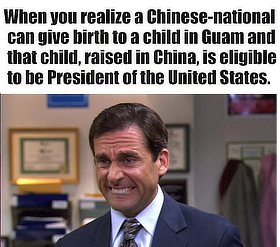
The Supreme Court just affirmed the possibility of a person raised for essentially his whole life in Communist China becoming president of the United States. It’s criminal...
Birthplace Citizenship Is Incompatible With Mass Immigration, by John Daniel Davidson, The Federalist, 1 July 2026:
A lot of people on the right are understandably upset about the Supreme Court's decision this week upholding birthplace citizenship under the 14th Amendment. It’s easy to see why. All one has to do is read the scathing dissents by Justices Samuel Alito and Clarence Thomas, which expose the flawed reasoning and intellectual dishonesty of the 5-4 majority - a majority that was clearly searching for a specific policy outcome and justifying it under the color of the Constitution...
The court's decision wouldn't be the catastrophe that it is if we hadn't just lived through a Democrat administration that demonstrated what a dangerous weapon mass illegal immigration can be in the hands of left-wing ideologues who want to remake America...
... granting citizenship to the native-born children of foreign nationals does a lot of the heavy lifting of assimilation. It gives immigrant families a stake in the nation, imposes obligations of service, and invites them to sink deep roots in American soil...
[but ] If we allow millions of people to enter our country illegally every year, and then grant citizenship to their children, after a decade or so we won't be the same country. It will completely transform America. Arguably, it already has...
... no self-governing republic can survive with large pockets of permanently domiciled noncitizens. When you allow people into your country permanently, but do not offer them or their offspring citizenship, what you end up with is what Europe has now: multiple generations of unassimilated communities of foreigners, taking over the country block by block, town by town...*
By the time it's obvious and undeniable what a profound mistake it was to combine mass immigration with birthplace citizenship, it will be too late. America as a nation and a republic will be finished. We’ll be something else entirely: a Balkanized, polyglot empire peopled not by self-governing citizens, but by subjects.
* Note: this myopic observation ignores the fact that Muslims are not assimilable because Islam is a political system of conquest. Issuing citizenship to them will not alter this fact.
Schweizer: More than a Million 'U.S. Citizens' Being Raised in China Due to Birth Tourism, Breitbart, 2 July 2026.
Cheer Up! The Birthright Citizenship Case Moves Us Toward Inevitable Victory, by Kurt Schlichter, Townhall, 1 July 2026:
Calm down about today’s birthright citizenship case, Trump v. Barbara. We were always going to lose. That was expected by anyone who understands how the courts work; what wasn’t expected is that this ruling was such a huge step toward eventual victory. You don’t have to be happy, but you don't have to freak out. We’re winning...
For about 150 years, the common legal understanding of the 14th Amendment has been that it provides that... anyone born in the United States is an American citizen. And the text of the amendment can be read to support that. Now, you don't have to like that, and you don't have to agree with that reading - like most of you, I think the stronger argument is the one against birthright citizenship for children of transients and illegal aliens...
Let's understand how the courts work. They don't like changing things. They revere precedent. It takes a lot to get a new understanding of the Constitution to become the mainstream interpretation...
Yeah, we lost today - barely. And that "barely" part is the good news. This was a 5-4 decision on the constitutional issue. Obviously, the three liberals voted against it because they will always vote the way that they perceive helps leftism...
This is huge, people. It’s enormous...
Here's the reality - we are one seat away from changing birthright citizenship. We win today, but this decision moves us forward. Frankly, I expected this evolving understanding of birthright citizenship - which I view as inevitable in the face of the reality of illegal alien anchor babies and birth tourism - to take a decade or two...
SCOTUS Doesn't Have The Final Word On Birthplace Citizenship, by John C. Eastman, The Federalist, 1 July 2026.
SCOTUS is turning the US Constitution into a UN constitution, by Matthew G. Andersson American Thinker, 1 July 2026.
President Trump Could End Most Birthright Citizenship With This 1 Simple Trick, by Athena Thorne, PJ Media, 30 June 2026.
Citizenship Cannot Be a Souvenir, by Benjamin M. Osborne, Chronicles, 1 July 2026.
Birthright Citizenship: Suicide of America via SCOTUS
The Predictable Disaster - video
Misinterpretation of the 14th Amendment to the US Constitution
Anchor babies, birthright citizenship, and the 14th Amendment
Birthright Citizenship: The Court Pointed the Way, by Frank Miele, Heartland Dairy USA, 12 July 2026:
... Even though Trump could not on his own change the application of the 14thAmendment's citizenship clause, Kavanaugh said Congress could.
"If Congress amends [the Nationality Act, a 1940 law that statutorily recognized Supreme Court precedent on birthright citizenship] or otherwise enacts a statute creating new exceptions along the lines of the Executive Order for children born to foreign citizens unlawfully or temporarily in the country, such a statute, as I see it, would pass constitutional muster," Kavanaugh wrote...
Section 5 of the 14th Amendment explicitly gave Congress the power to resolve the issue through legislation...
What is needed is legislation to define the meaning of "subject to the jurisdiction." The phrase itself remains undefined in the Constitution...
Majority Leader John Thune has shown himself unwilling to discard the filibuster for the sake of the election reforms contained in the SAVE America Act. But maybe if the future of the country were on the line with an opportunity to redefine citizenship, Thune would find his courage...